Every project inventory will have projects that are similar. A Public Works Department will have groups of road projects, drainage projects, street lighting projects and of course unique projects like the annual
placement of Christmas decorations on lamp poles. An IS department will have groups of hardware upgrades, applications development projects, legacy systems conversions, and so on.
Project # |
Project Title |
W3-174 |
Depot Road Water Main Replacement |
W3-244 |
Central Street Water Main Replacement |
W1-168 |
Pumping Station #4 Refurbishment |
H2-191-2 |
Computer System Hardware Upgrade |
W4-183 |
Westborough Water Storage Capacity Increase |
H0-165 |
Processes Analysis Project |
The table at the right, a shortened project inventory from a water district, shows that the first two projects, water main replacements, are similar and are
identified as such by the "W3" code in their project numbers.
The point when it comes to managing multiple projects is to avoid treating every project as if it is one-of-a-kind.
Grouped projects provide important efficiencies when managing multiple projects. They provide focus, streamline management, promote systems and procedures, and facilitate contract management.
- Grouped projects build focus
Small organizations with 5-10 projects do not experience major difficulties with focus, but focus becomes a problem as the project inventory grows to 50-100
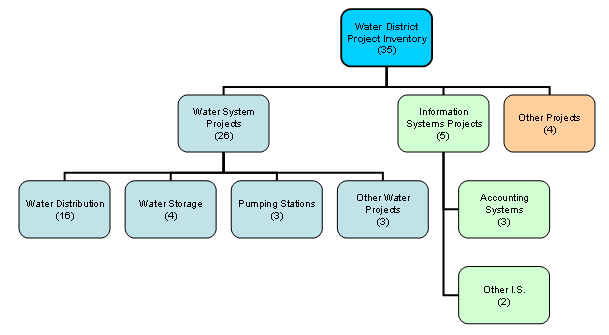
or more projects and overwhelmed team members lose their vision of what it is they are working on and why. Here we see how the water district has grouped
its projects in what amounts to a work breakdown structure of its project inventory. The numbers in parentheses indicate the total in each group of projects.
- Grouped projects streamline management
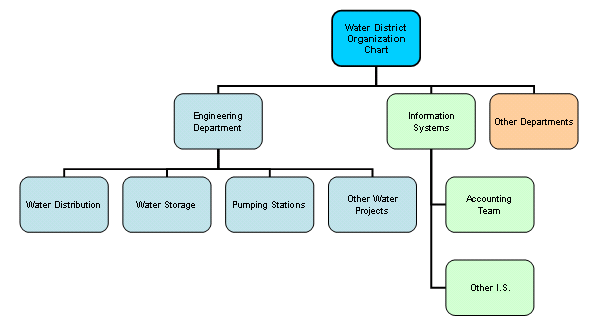
Here we see an example of how the organization itself can be organized as the water district's Engineering and Information Systems Departments
themselves have been organized around the major project groups. Just as water distribution was distinguished from water storage in the previous diagram,
here the water distribution engineering team is distinguished from the water storage engineering team. Specialization is one way to streamline
management and add focus to an organization's projects.
- Grouped projects support project standardization
Standards like policies, systems, procedures, checklists, forms, reports and planning templates
can be built around groups of projects. Anything that can be
standardized will be beneficial because familiarity builds experience and re-use saves effort that would be spent on reinvention. In the case of the water
district, when water mains need to be replaced, something a water district does regularly, a schedule template built for previous water main projects can be
used to plan the project. In addition a standard contract template can be modified with particulars about each water main replacement. Standard reports
can apply across several groups of projects, and contractors can make use of them as well.
Grouped projects also enhance the ability to develop project-specific policies. Policies are characteristics of organizations, but more specific policies can be
applied to projects. An organization might have a policy to support small businesses, for example, but it might not be clear how that policy is to be carried
out on specific projects. Once projects have been grouped, organizational policies can be applied across a group of projects and new policies can be
developed that are specific to the needs of the project groups.
Organize the organization for better multi-project management with Turnkey Managing Multiple Projects.
Learn the fundamentals of PM and plan projects in the
Project Management Workshop.
Learn and apply techniques for managing multiple projects in the Multiple Projects Skill Building Workshop.
More PM Tips
to receive notices of new PM Tip Sheets as they are published.
to leave the PM Tip Sheets subscription list.
Privacy Policy: Email addresses are for the subject of correspondence only. |