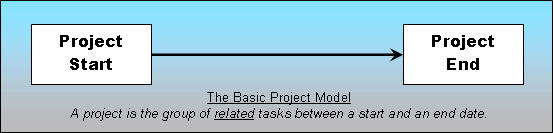
A project is a group of related tasks that fall between a start and an end date, though not everyone sees projects that way. The first step to better management of multiple projects is to get everyone to agree on what is or isn't
a project. Policies, objectives, on-going operations and even opinions can seem project-like but without clear starts, finishes and related tasks, they are not projects. Pet projects and
start-stop projects, may or may not be projects. They are actually distractions when they draw time and resources away from an organization's "authorized" projects.
The tips that follow
will help to separate actual projects from on-going operations, non-projects and quasi-projects, and clear the way for the second and third steps toward managing multiple projects:
developing project titles and building a project inventory.
- How to avoid confusion between projects and other concepts.
The concept of what a project is can be confused with
mission statements, organizational objectives, directives, initiatives and a dozen other terms that may
be related to projects, but are not projects themselves. The simplest test is that a project will have a clear beginning and end which would rule out mission
statements, on-going operations, directives, initiatives and organizational objectives since they exist in perpetuity.
Directives and initiatives are usually made up of projects.
Consider a nonprofit that provides grants for example. It would not be unusual to see a
statement, call it a directive, that the organization plans to disburse annual amounts of a certain type of grant. Grants, however, tend to be disbursed at
intervals called "funding rounds" throughout the year. In this case, each funding round would be a project. Calling the directive itself a "project" would
collect all the grant rounds into one overwhelming, formless project.
- Project Management for projects; operations management for on-going work.
Facilities management and information systems groups, for example, have maintenance projects, but they often neglect to distinguish between a
maintenance as a project and maintenance as an on-going operation. True maintenance projects come to closure so a facilities team installing a new air
conditioner on a building, or an IT team bringing up a new operating system would be working on projects. Regularly scheduled preventive maintenance
on the air conditioner or handling routine upgrades to an operating system are on-going work which is better suited to operations management than project management.
Use caution with "start-stop" and "pet" projects.
Beside a start and a finish date,
a project's tasks need to be related to one another, such as when Task A needs to finish before Task B can start. Start-stop projects,
where one task can finish but the next task may or may not start, bend the concept of a project to the breaking point. Legal cases are an example of start-stop
projects which, incidentally, is why project management has not made many inroads into the legal profession. Start-stop projects have such indeterminate
outcomes, like a civil case that might settle, go to trial, be dropped or drag on, that they are better managed by CRM, risk management and contingency planning than a schedule.
  Inadequate resources are another cause of start-stop projects. An organization that is understaffed will often compensate by shifting
personnel between one project and another. This erodes productivity as people and priorities shift from project to project like bees seeking
nectar. One of the attributes of project management as it applies to managing multiple projects is that it balances staffing and projects so
that there is neither too much nor too little of one or the other. Inadequate resources are another cause of start-stop projects. An organization that is understaffed will often compensate by shifting
personnel between one project and another. This erodes productivity as people and priorities shift from project to project like bees seeking
nectar. One of the attributes of project management as it applies to managing multiple projects is that it balances staffing and projects so
that there is neither too much nor too little of one or the other.
Pet projects, by comparison, are outside of the realm of project management since they exist because of a whim rather than a mandate. Pet
projects serve an individual's needs rather than the organization's and compete with actual projects by siphoning off their resources. Pet
projects extract a heavy toll in what financial managers call opportunity losses.
Start on the road to better multiple project management by using the tips above to separate projects from non-projects. A helpful next step will be to check the quality of each project's title
since references to the project's title will be used throughout its development, and possibly beyond. Managing Multiple Projects is a consulting service that organizes multiple projects.
The Multiple Projects Workshop
provides learning and application of multiple project management techniques.
More PM Tips
to receive notices of new PM Tip Sheets as they are published.
to leave the PM Tip Sheets subscription list.
Privacy Policy: Email addresses are for the topic of correspondence only. |